
Hello, I am Advocate Brownie Ebal
I am a legal Practitioner, Venture Capitalist and Philanthropist.
Welcome to my site.
I love life, travelling, food, beauty, the law, leadership and meeting people from diverse backgrounds. I hope to inspire each one of you with my various articles as I share from my experiences around our beautiful world.
I live in Kampala, Uganda.



-
Article 71: From Compliance to Accountability: Corporate Governance in a Technology-Driven Era.
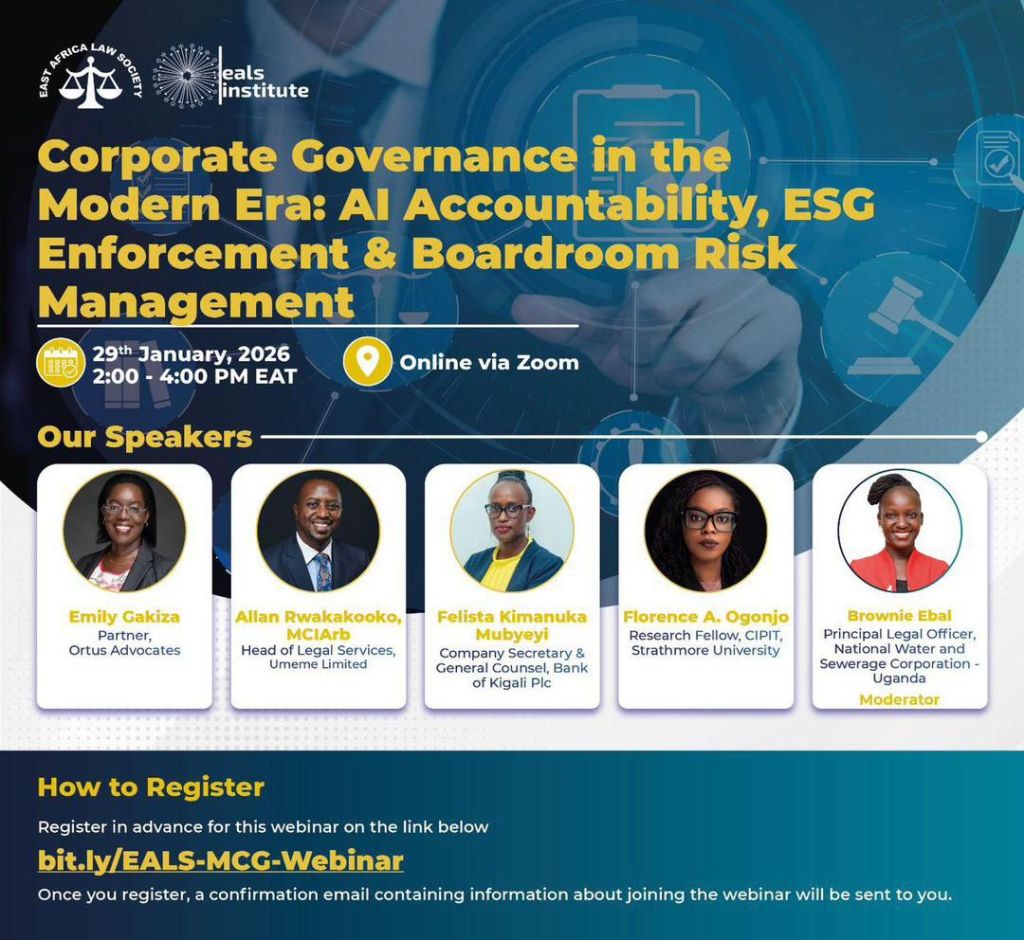
On 29th January 2026, the East Africa Law Society convened a regional webinar bringing together legal practitioners, in-house counsel, board advisers, and governance professionals to examine the evolving demands of corporate leadership. Held under the theme Corporate Governance in the Modern Era: AI Accountability, ESG Enforcement & Board Risk Management, the session explored how technology, sustainability expectations, and risk oversight are reshaping decision-making across African boardrooms.
The discussion was framed around a shared recognition that corporate governance is no longer defined solely by compliance structures or periodic board reporting. Artificial intelligence is already influencing strategic, operational, and human-resource decisions; ESG considerations are rapidly moving from voluntary commitments to measurable obligations; and boards are increasingly expected to anticipate risks that are dynamic, interconnected, and often unfamiliar. The webinar therefore sought to move beyond surface-level conversations and engage with how governance must adapt in practice.
The conversation on artificial intelligence was anchored by Florence Anyango, an advocate of the High Court of Kenya and a research fellow at Strathmore University’s Centre for Intellectual Property and Information Technology. She observed that AI systems are already embedded across sectors such as finance, recruitment, supply chains, and strategic planning, often without clear visibility at board level. By distinguishing between AI-supported, AI-triggered, and fully automated decisions, Florence illustrated how technology now shapes outcomes affecting employees, consumers, and markets. She cautioned that these developments introduce significant legal, ethical, and reputational risks, particularly where decisions are opaque, difficult to contest, or directly affect individuals. While many African jurisdictions do not yet have AI-specific legislation, she noted that existing legal frameworks on data protection, non-discrimination, labour relations, consumer protection, and human rights already impose real accountability. Drawing from regional and global instruments, including UNESCO’s ethical principles, the OECD AI guidelines, and the African Union’s AI Continental Strategy, she underscored the importance of transparency, human oversight, and a people-centred approach to AI deployment.
Building on this foundation, Emily Disa, a partner at Ortus Advocates and a seasoned finance, risk, and governance professional, shifted the focus to board-level risk management. She situated AI and ESG within a broader risk environment defined by volatility, cyber threats, climate-related disruptions, and rapid digital transformation. Emily noted that boards are increasingly expected to oversee risks they may not fully understand, yet ignorance offers no protection from liability or reputational damage. She highlighted cyber security and data governance as foundational risks, given the growing value of data and the rise of AI-enabled attacks, and warned that failures in these areas can escalate quickly into regulatory and public-trust crises. Her remarks emphasised the need for boards to integrate emerging risks into existing governance structures, strengthen oversight through dedicated committees, and invest in continuous education and scenario planning.
The discussion on sustainability and accountability was further enriched by Felista Kim Manuka, General Counsel and Company Secretary at Bank of Kigali PLC, who examined ESG from both a governance and business perspective. She explained that ESG has moved decisively from being a reputational or voluntary exercise to a strategic and regulatory priority. Felista highlighted the tangible benefits of embedding ESG into corporate strategy, including operational efficiency, enhanced investor confidence, improved access to capital, and stronger employee engagement. She also underscored the critical role of boards in setting the tone on ESG, overseeing disclosures, and guarding against greenwashing by ensuring that sustainability claims are supported by credible data and governance processes. Reference was made to emerging regional practices and global standards such as the International Sustainability Standards Board and climate-related financial disclosure frameworks, which are increasingly shaping expectations across African markets.
Offering a practitioner’s perspective, Alan Rakoko, Head of Legal Services at Umeme Limited, reflected on the growing exposure of boards, senior management, and legal advisers to personal and institutional liability. He noted that regulatory trends across the region are steadily expanding accountability beyond the corporate entity to individual decision-makers, particularly in regulated sectors. Alan emphasised that ESG reporting, AI governance, and integrated reporting are no longer optional add-ons but core components of corporate risk management. He drew attention to evolving governance frameworks, including the latest developments in the King V Report, which reinforce the need for ethical leadership, stakeholder inclusivity, digital responsibility, and proactive oversight of technology-driven risks.
Throughout the webinar, a consistent theme emerged: governance in the modern era requires anticipation rather than reaction. Whether engaging with artificial intelligence, strengthening ESG oversight, or managing board-level risk, organisations must move beyond policy adoption to meaningful implementation. The session concluded with a call for governance professionals to translate global principles into local practice, ensuring that emerging technologies and sustainability commitments are aligned with African realities, institutional capacity, and public trust.
For more, please watch full video: https://www.youtube.com/live/Ppbx3tQWsf8
-
Article 70: The 5 Jars Principle: A Faith-Centred Approach to Financial Stewardship
Money is one of the earliest tools of independence most people encounter, yet it is rarely accompanied by wisdom on how to manage it well. For many young adults, income arrives before instruction, and financial decisions are made through trial, pressure, or imitation rather than intention. The result is often confusion, anxiety, debt, and a fractured relationship with money. The 5 Jars Principle offers a simple yet profound framework that restores clarity, discipline, and purpose to personal finance, while anchoring financial decisions in faith and values.
At its heart, the 5 Jars Principle is not merely a budgeting method; it is a stewardship mindset. It teaches that money is not owned absolutely, but entrusted. This perspective shifts the focus from consumption to responsibility, from impulse to planning, and from scarcity to purpose. By assigning every portion of income a role before spending begins, individuals learn to lead their money rather than react to it.
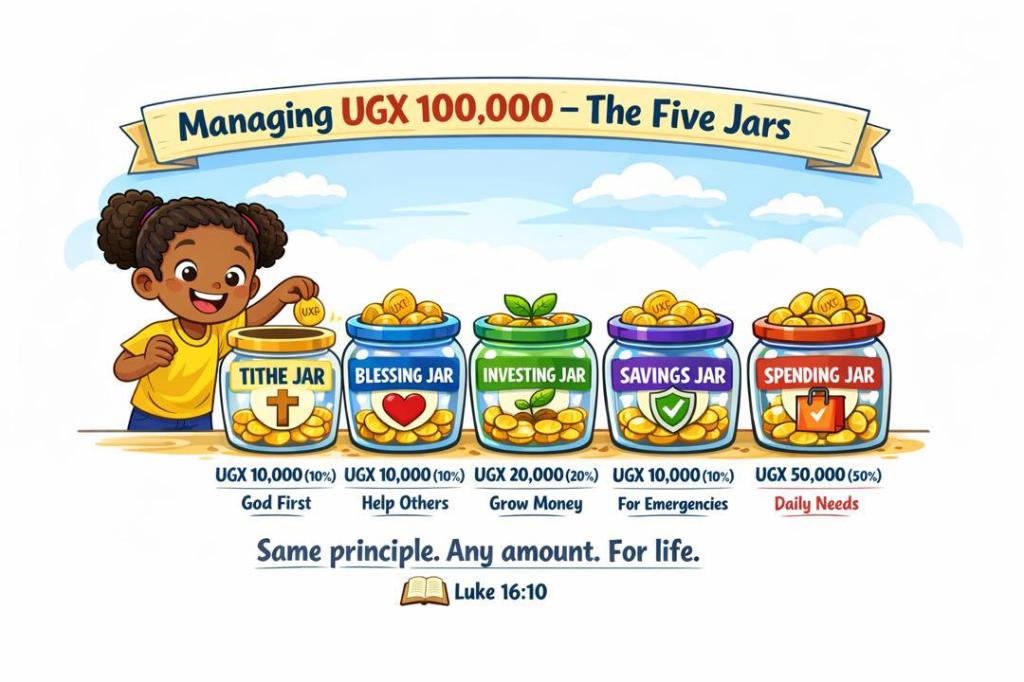
The principle is often taught using physical jars, especially for children and young adults, because it transforms an abstract concept into a visible, practical habit. Each jar represents a clear financial priority. As income is received, it is intentionally divided, reinforcing the idea that wise financial living is proactive, not accidental. Over time, this practice shapes character as much as it shapes bank balances.
When applied consistently, the 5 Jars Principle nurtures financial maturity by integrating faith, generosity, growth, preparation, and enjoyment into one coherent system. It recognises that financial health is not achieved by focusing on one area alone, but by maintaining balance across all aspects of life.
The five jars are introduced as follows.
The first jar is the Tithe Jar, which represents putting God first. This jar is set aside before anything else, affirming that God is the source of all provision. By honouring God with the first portion of income, individuals cultivate gratitude, humility, and trust. Scripture reminds us, “Honor the LORD with your wealth, with the firstfruits of all your crops” (Proverbs 3:9), and further affirms that “a tithe of everything… belongs to the LORD” (Leviticus 27:30). Tithing is therefore not framed as loss, but as alignment — a declaration that faith governs financial decisions. This practice trains the heart to depend on God rather than money and establishes spiritual order in personal finances.
The second jar is the Blessing Jar, dedicated to generosity towards others. This jar reflects the understanding that money is also a tool for compassion and community. Through intentional giving, individuals learn to look beyond themselves and recognise the needs around them. The Bible teaches, “Give, and it will be given to you” (Luke 6:38), and also assures us that “a generous person will prosper; whoever refreshes others will be refreshed” (Proverbs 11:25). Generosity builds empathy, strengthens relationships, and reminds us that wealth finds its highest purpose when it uplifts others. This jar guards against selfishness and nurtures a lifestyle of kindness and service.
The third jar is the Investing Jar, which focuses on long-term growth. Here, individuals are encouraged to think beyond immediate needs and pleasures, and to plan for the future with wisdom and diligence. Scripture affirms this principle clearly: “The plans of the diligent lead surely to abundance” (Proverbs 21:5), and “whoever gathers money little by little makes it grow” (Proverbs 13:11). Investing teaches patience, discipline, and responsibility. Whether through education, entrepreneurship, or structured investments, this jar equips individuals to grow resources steadily and sustainably over time.
The fourth jar is the Savings Jar, which prepares individuals for life’s uncertainties and opportunities. Saving is an expression of wisdom and foresight. The Bible uses the example of the ant to illustrate this truth: “Go to the ant, you sluggard; consider its ways and be wise” (Proverbs 6:6). It further states that “the wise store up choice food and olive oil” (Proverbs 21:20). By setting aside funds for emergencies or future needs, individuals avoid panic-driven decisions and unnecessary debt. This jar fosters peace of mind and reinforces the value of preparation.
The fifth and final jar is the Spending Jar. After honouring God, giving generously, investing wisely, and saving intentionally, individuals are free to enjoy what remains responsibly. Scripture affirms that enjoyment, when rightly ordered, is part of God’s design: “There is nothing better for people than to enjoy their work… this is a gift from God” (Ecclesiastes 3:13). This jar acknowledges that balance matters — life is meant to be lived fully, not anxiously. By placing spending last, the system ensures that enjoyment does not undermine stewardship, but flows from it.
What makes the 5 Jars Principle particularly effective is its simplicity. It is easy to understand, easy to teach, and easy to adapt to different income levels. More importantly, it works because it aligns behaviour with values. It removes ambiguity from financial decisions and replaces it with clarity. Every coin has a purpose, and every choice becomes intentional.
For young adults especially, this framework lays a strong foundation. It encourages living within one’s means, avoiding unnecessary debt, building financial resilience, and developing a healthy relationship with money early in life. Over time, the jars may change in size as income grows, but the principles remain constant.
Ultimately, the 5 Jars Principle reminds us that financial wisdom is not separate from spiritual life. How we manage money reflects what we value, what we trust, and what we prioritise. When finances are stewarded with intention and faith, they become a source of peace rather than pressure, and a means of purpose rather than anxiety.
Wise stewardship is not about how much we earn, but how faithfully we manage what we receive.
For further reading and additional perspectives on the 5 Jars Principle:
-
Article 69: Ready to Stand Out in the Legal Field? Start with Visibility and Positioning

In today’s legal world, talent alone is not enough. Over the years, I have learned that if you want to grow, to lead, and to create real impact, you must be visible, intentional, and deliberate about how you position yourself. It is no longer enough to simply be good at your job, people need to know what you do, how well you do it, and what value you bring.
On April 3rd, 2025, I shared these insights during a Zoom mentorship session hosted by Zubedah Namugenyi , under the theme “Ready to Stand Out in the Legal Field? Secrets to Visibility & Positioning.” I reflected on my journey as a Principal Legal Officer at the National Water and Sewerage Corporation (NWSC), and on the practical steps that continue to shape my professional presence.
I emphasized a principle that guides me daily: you are your own CEO. Personal branding is not a mask or a performance, it is simply the alignment between your work, your growth, and how you show up in the world. If a particular area of law excites you, speak about it boldly. Write about it. Share your thoughts. The more consistently you show up in your niche, the more naturally people begin to associate you with it.
I also challenged the common belief that hard work alone guarantees progress. Competence is important, but it is not the full story. Many people excel in their work. What distinguishes you is the visible, measurable value you bring. Ask yourself: What am I doing that sets me apart? What contribution can others see and feel?
Another key area we explored was visibility within the workplace. One of the most effective ways to stand out is to add value beyond what is expected. Support your team. Make your supervisors’ work lighter. Deliver results with excellence and speed. When you collaborate across departments, offer solutions, and make your contribution known in a professional way, your recognition grows naturally.
We also discussed the role of social media in shaping a professional identity. I shared something I have witnessed repeatedly: social media is not about your title, it is about your content. Whether you are senior or junior, your voice matters. Consistently posting or engaging with thoughtful content expands your visibility and often attracts like-minded professionals. Every comment, every shared idea, every thoughtful reflection builds your digital presence.
At the heart of the conversation was an issue many legal professionals wrestle with, imposter syndrome. I encouraged participants not to wait for a perfect moment or complete knowledge before stepping forward. You do not need to know everything to contribute; start from where you are. Growth happens as you show up, not before.
I also highlighted the importance of navigating workplace dynamics wisely. Overlooking hierarchy, mishandling authority, or ignoring organizational culture can create unnecessary setbacks. For those seeking clarity on this, I recommended the book “How Not To Advance In Your Career: Career Limiting Moves” by Ruby Engena Obote (Mrs), which offers practical insights—and its summary is available on my website, brownieebal.com.
And finally, I shared a principle that continues to anchor me: stay focused despite negativity. Not everyone will celebrate your progress, but your purpose should remain undistracted. Let your work speak. Build allies who uplift, challenge, and support you, not for gossip, but for growth.
At its core, standing out in the legal field requires clarity, consistency, and courage. Be authentic. Own your niche. Learn deeply. Speak boldly. Write with conviction. When you pour into your craft, confidence becomes a natural outcome.
Success does not happen in silence. You must show up, and sometimes, you must show up afraid.

-
Article 68: Navigating Emotional Wellness of a Woman in the Workplace.

On 6th March, 2025, the Parliament of Uganda hosted a Zoom discussion under the theme “Navigating Emotional Wellness of a Woman in the Workplace.” The session aimed to equip women with strategies for managing emotions, maintaining balance, and fostering resilience in professional spaces. The panel featured Lindsay K. Nzeyi, Executive Director of Break Free Treatment & Rehabilitation Center; Gabriel Kagume, Financial Literacy and Masterclass Trainer; and Rose Ikiror Semakula, Deputy Clerk – Parliament Affairs.
The discussion highlighted the emotional struggles women face at work, how external pressures influence professional well-being, and the steps women can take to maintain balance.
Workplace stress is not always a result of professional responsibilities alone. Emotions from outside work—such as personal struggles, family obligations, or financial pressures—can spill into the workplace, affecting concentration and performance. Unresolved personal issues may also manifest in professional interactions, leading to conflicts or emotional exhaustion.
Burnout is another common challenge, often caused by excessive workloads, competition for promotions, or the pressure to meet financial obligations. Taking on too many responsibilities beyond one’s capacity can lead to exhaustion, reduced productivity, and loss of enthusiasm for work. Financial insecurity further contributes to emotional strain, especially when individuals feel pressured to overwork in order to meet financial demands.
Below are some of the recommended solutions;
- Expressing oneself openly: Confidence in communication is essential for a healthier workplace experience. Addressing concerns, seeking support, and articulating professional needs can help create a more balanced work environment.
- Acknowledging and managing emotions: Recognizing how emotions impact performance allows for better regulation. Strategies such as journaling, seeking mentorship, or practicing mindfulness can be useful in processing emotions constructively.
- Setting boundaries: Taking on excessive workloads does not always guarantee success. Prioritizing core responsibilities and maintaining a sustainable work pace can help prevent burnout.
- Developing financial independence: Financial stress can be managed through budgeting, financial literacy education, and exploring additional income sources. Books such as How Come That Idiot Is Rich and I Am Poor? and Where Did My Money Go? were recommended for better financial management.
- Building a strong support system: Consulting the right people for both personal and professional advice provides valuable guidance and helps in navigating workplace challenges more effectively. Seeking mentorship, professional networks, or trusted individuals with relevant experience can offer meaningful support and perspective.
- Focusing on personal growth: Defining individual goals and staying committed to them ensures a more fulfilling career path rather than engaging in unnecessary competition.
- Resilience: Emotions are a natural part of life, but knowing when and how to react is crucial. Practicing composure in challenging situations, maintaining humility, and taking responsibility for personal success all contribute to emotional wellness.
In conclusion, the discussion reinforced the importance of emotional awareness, financial stability, and effective communication in maintaining workplace well-being. Navigating emotional wellness requires setting boundaries, managing stressors constructively, and fostering resilience. By applying these strategies, a balanced and fulfilling work experience can be achieved.
-
Article 67: The Intelligence Trap: 7 Mistakes Smart People Make

On 28th August, I joined a LinkedIn Live hosted by Pepe Menambo with guest Mr. Yengeni, reflecting on a theme that was as sobering as it was insightful: The Intelligence Trap—Seven Mistakes Smart People Make.
At first glance, this might sound like a conversation only for top executives, but as Mr. Yengeni emphasized, “We are all smart.” Every contribution at work, every idea born in our minds, is evidence of intelligence. The question is not whether we are smart, but whether our intelligence is working for us or against us.
The discussion unpacked several common traps:
1. Relying on intelligence alone.
Being smart is valuable, but intelligence does not thrive in isolation. Many successful CEOs understand this, which is why they negotiate for room to build the right teams and bring in critical talent. Brilliance without a support system risks being wasted, while intelligence combined with the right environment creates impact.
2. Working hard in silence.
A common trap is believing that hard work alone will speak for itself. Someone may write an excellent report but never step into the boardroom where decisions are made. As Yengeni put it, “You cannot sell a secret. The mouth that keeps quiet never gets help.” Competence needs visibility; otherwise, opportunities remain out of reach.
3. Overusing strengths.
What begins as a strength can become a weakness if not managed well. Being articulate is useful, but talking too much in an interview can overshadow the very message you want to pass across. In the same way, posting endlessly on social media can weaken your personal brand rather than strengthen it. Strategy, moderation, and timing keep strengths effective.
4. Becoming trapped by hard work.
Sometimes, working too well at your job makes you so valuable to your boss that you cannot easily be promoted or released. It is possible to spend 15 years in one company and only move two steps up because you were always too busy working on the job, not on yourself. Hard work needs to be balanced with self-investment and a deliberate career plan.
5. Undervaluing yourself in salary negotiations.
One of the most common mistakes is answering “anything” when asked about expected pay. This reflects a lack of self-worth. Researching market standards and knowing your value allows you to negotiate confidently. The panelists noted that the first five years of a career are for learning, but between five and ten years, it’s also about earning.
6. Over-profiling or misbranding.
In the effort to appear impressive, some professionals overstate their profiles—labeling themselves as “Founder” or “CEO” while still seeking entry-level roles. This creates confusion and may even close doors. A profile should be precise and aligned with the stage you are in, not one that sends the wrong signals.
The conversation made it clear that the “intelligence trap” is not about a lack of brilliance but about how brilliance, when unchecked, turns into a stumbling block. From being too quiet to being too loud, from undervaluing to over-inflating ourselves, these mistakes can undermine even the smartest among us. The true measure of intelligence, therefore, is not just being smart, but being strategic in how that intelligence is applied.

About Me
I love reading, writing, attending events, learning, leadership and meeting new people.
I hold a Masters Degree in International Law and I am passionate about life.
If you are interested in learning more about self discovery and becoming the best version of yourself.
Follow Me On
Subscribe To My Newsletter
Subscribe for new stories and exclusive content.

