
Have you ever noticed how differently people respond to the same situation? Give four people the same deadline and one may immediately create a plan, another may remain completely relaxed, a third may analyse every detail, while the fourth may first think about everything that could go wrong.
That is part of what makes personality so interesting.
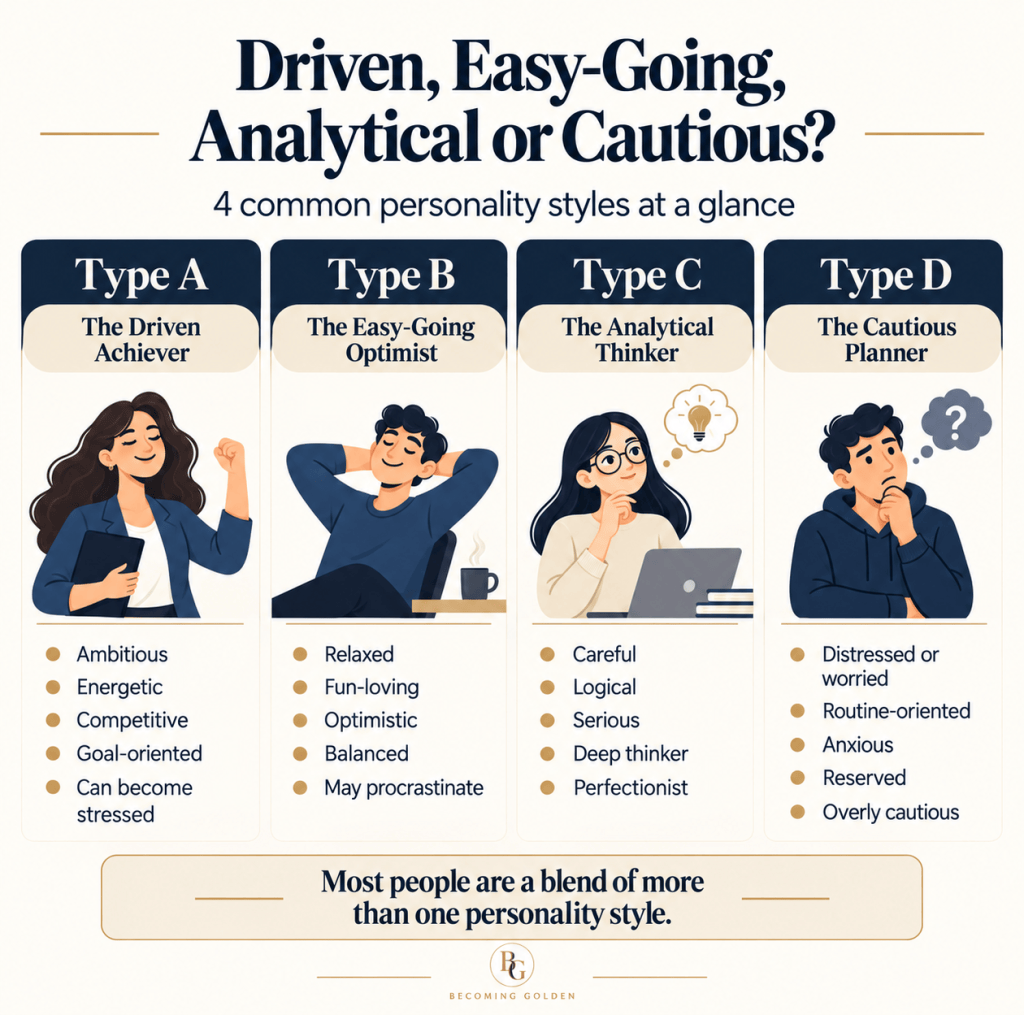
One popular way of looking at behavioural tendencies groups people into four broad styles: Type A, Type B, Type C and Type D. These are not strict labels, and most people will probably recognise themselves in more than one. Still, they can help us understand how we approach work, pressure, decisions and everyday life.
The Driven Achiever
Type A personalities are often energetic, ambitious and competitive. They like goals, progress and results, and are usually not afraid of hard work.
This drive can be a major strength. Type A people often take initiative, push projects forward and challenge themselves to achieve more. The difficulty comes when everything starts to feel urgent. Ambition can turn into stress, impatience or the feeling that there is always one more thing to accomplish.
For the Type A personality, the lesson may not be how to work harder, but how to recognise that slowing down does not mean losing ambition.
The Easy-Going Optimist
Type B personalities tend to take a more relaxed approach. They are often easy-going, optimistic, fun-loving and less concerned with competition.
Their calm nature can be especially valuable when everyone else is under pressure. They may be the person reminding the team that a problem can still be solved without panic.
However, being laid-back can sometimes turn into procrastination. There is a difference between remaining calm and continuously putting off what needs to be done.
The challenge for Type B personalities is finding the balance between enjoying the journey and maintaining discipline. Being relaxed and being responsible can exist together.
The Analytical Thinker
Some people prefer to think carefully before taking action. Type C personalities are often logical, serious, hardworking and detail-oriented.
They tend to ask questions, examine the facts and consider different possibilities before making a decision. This can make them particularly valuable in situations where accuracy and careful judgement matter.
The challenge is that careful thinking can become overthinking. A desire to get everything exactly right may make it difficult to move forward.
Type C personalities may therefore need to remember that not every decision requires perfect information. Sometimes progress means making the best decision possible with what is available.
The Cautious Planner
Type D personalities are generally associated with caution, sensitivity to pressure and a preference for routine and predictability.
While caution can sometimes be viewed negatively, it also has its advantages. A cautious person may identify risks that others overlook and help a team think through possible problems before acting.
The difficulty comes when concern becomes so strong that it prevents action altogether.
For the Type D personality, the goal is not to stop being careful, but to distinguish between healthy caution and unnecessary worry.
Perhaps We Are a Mixture of All Four
The truth is that many of us probably do not fit neatly into one category.
You may be highly Type A at work but completely Type B when relaxing with friends. You may become Type C when making an important financial decision and more cautious when facing an unfamiliar situation.
That is why these personality styles are most useful as a tool for self-awareness, rather than as permanent labels.
Each personality brings something valuable. The driven person brings momentum. The easy-going person brings calm. The analytical person brings attention to detail. The cautious person brings awareness of risk.
At the same time, each personality has something to manage. The ambitious person may need to slow down. The relaxed person may need to act sooner. The perfectionist may need to accept that good can sometimes be good enough, while the cautious person may need to take a calculated risk.
Ultimately, understanding personality is not about deciding which letter belongs beside your name. It is about recognising how you naturally respond to life, where your strengths lie and where you may need to grow.
 BecomingGolden
Leave a comment