
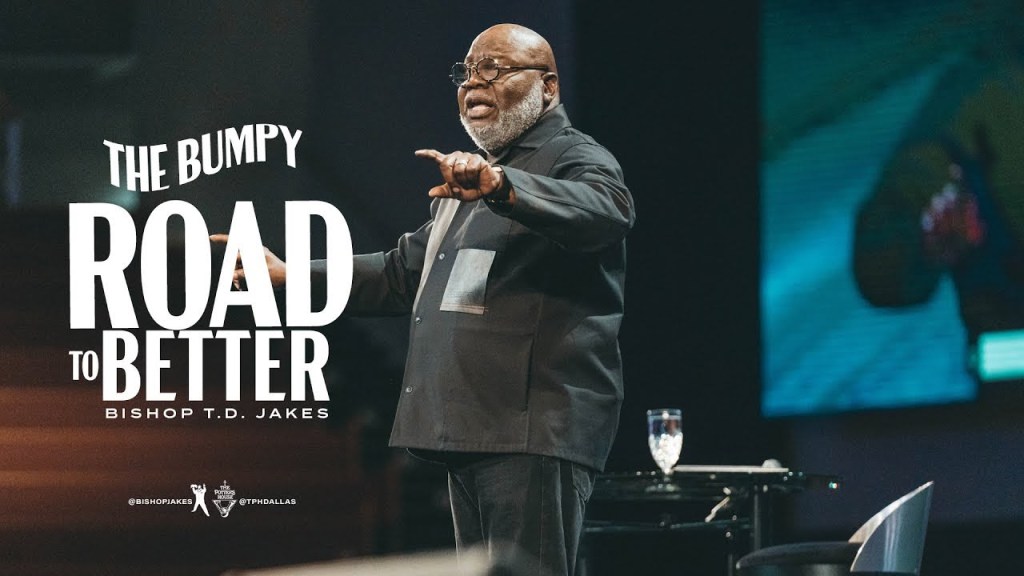
In his motivational sermons on TBN, T.D. Jakes shares a powerful message about overcoming life’s obstacles and moving into the next level of God’s promise. His words remind us that the journey to better is not always easy, smooth, or comfortable. As he says, “The road to better is bumpy.” This message speaks to anyone who has faced delays, disappointments, pressure, confusion, or seasons where life seemed to be moving in the opposite direction of their prayers. Yet, through his teaching, T.D. Jakes encourages us to understand that the bumps in the road are not always signs of defeat. Sometimes, they are signs that we are being moved, shaped, and prepared for what God has ahead.
Life has a way of teaching us that progress is often uncomfortable. Many people desire growth, success, healing, stability, and breakthrough, but few people want the difficult process that often leads there. We want the promise, but we may not always welcome the pressure that pushes us toward it. However, the truth is that no meaningful transformation comes without stretching. The difficult moments we face may feel like setbacks, but they can also become the very path God uses to move us into a better place.
T.D. Jakes speaks about seasons of famine, not only as a lack of food, but as any season where something important feels missing. It may be a famine of peace, opportunity, love, support, clarity, or direction. These are the seasons that expose where we have become too comfortable, too passive, or too afraid to move. They force us to confront the truth that faith must be accompanied by action. Prayer is important, but there are moments when we must stop looking at the problem and begin moving toward the solution.
Many people remain stuck because they expect change without movement. They desire new results while staying in the same place, repeating the same patterns, and holding the same mindset. But better often requires movement. As T.D. Jakes says, “You got to move.” That movement may not always be easy. It may require courage, sacrifice, and the willingness to step forward even when things are still uncertain. Sometimes, the pressure we feel is not there to destroy us, but to push us out of the place where we have become too settled.
The difficult seasons of life also reveal what we are holding on to. Pain has a way of making people cling tightly to what feels safe. After disappointment, we may hold on to relationships, habits, memories, money, positions, or past versions of ourselves because we are afraid of losing again. We may think we are holding on out of love, but sometimes we are holding on out of fear. Fear tells us that this is all we have left, that nothing better will come, and that if we release what is in our hands, we will be left with nothing.
However, fear can limit growth. When we hold on too tightly, we may block the healing, restoration, and new direction that God is trying to bring into our lives. Sometimes, what we are afraid to release is connected to the next level of our journey. The process may be painful, but it may also be necessary. Growth requires us to examine not only what we have lost, but also what we are still carrying because of that loss.
Through the story of Joseph, T.D. Jakes reminds us that pain does not have to make us bitter. Joseph went through betrayal, rejection, separation, and hardship, yet he did not allow those experiences to poison his heart. When he eventually found himself in a position of power, he did not use that power for revenge. Instead, he used it to preserve life, restore family, and release others from guilt. That is a powerful lesson. True favor is not just about being lifted higher; it is about being mature enough to handle the height.
Many people desire influence, honor, and open doors, but the real question is whether they can be trusted with them. Can we be trusted with success without becoming proud? Can we be trusted with power without becoming vindictive? Can we be trusted with favor without using it to punish those who once hurt us? Sometimes, the delay is not because we lack talent. It may be because our hearts still need healing. We may have the ability to go further, but bitterness, anger, and unresolved pain can quietly stand in the way.
The journey to better is therefore not only external; it is deeply internal. It is not only about getting a new opportunity, a new job, a new platform, or a new level of recognition. It is also about becoming the kind of person who can carry those blessings well. Better is not just about having more. It is about becoming whole, mature, wise, and strong enough to use what we have been given for a greater purpose.
There are also seasons in life that feel like night. In those seasons, clarity may not come all at once. We may not see the full picture. We may only receive small glimpses of hope, small signs of direction, and brief moments of encouragement. But sometimes, a flicker of light is enough to keep going. A small reminder, a word of encouragement, a moment of peace, or one open door can give us the strength to continue.
In the night seasons, we must learn to listen carefully. Sometimes, what we hear in our spirit may not make sense to everyone around us. Others may not understand the call, the dream, the burden, or the direction because they did not hear what we heard. That does not always mean they are against us. Sometimes, they simply do not have the same revelation. This is why wisdom matters. The young may hear the call, but the older may know the way. Strength and experience must learn to work together.
Every generation has something valuable to offer. The young often bring energy, courage, innovation, and fresh vision. The older often bring wisdom, interpretation, patience, and lessons learned through experience. When both work together, purpose becomes clearer. The future is not built by rejecting the past, and the past should not fear the future. Growth happens when humility allows us to learn from one another.
One of the strongest lessons from this message is that God can bring us back to the place of our pain, not to shame us, but to heal us. The place where we once felt rejected can become the place where we are restored. The place where we felt confused can become the place where we finally understand. The place where we almost gave up can become the place where purpose is awakened again. What once looked like shame can become a testimony.
This is why we must not despise the bumpy road. The discomfort, the pressure, the waiting, the stretching, and the unexpected turns may all be part of the process. The road may be difficult, but difficulty does not mean defeat. Sometimes, it means we are closer than we think. The bumps are not always a sign that we are lost; they may be a sign that we are being moved, shaped, healed, and prepared for better.
In the end, better is not simply a destination. It is a transformation. It is the person we become after the famine, after the fear, after the night season, and after the pain. It is the maturity to move when movement is required, the courage to release what fear has made us hold, the grace to forgive when we could seek revenge, and the humility to hear God’s voice even in uncertain places.
The road to better may not be easy, but it is worth it. Every bump can become part of the testimony. Every delay can carry a lesson. Every painful season can produce strength. And every step forward, no matter how small, can bring us closer to the life, purpose, and breakthrough we were created for.
For more insights, watch the full sermon here: https://youtu.be/11KwqBOiKFo


Leave a Reply