
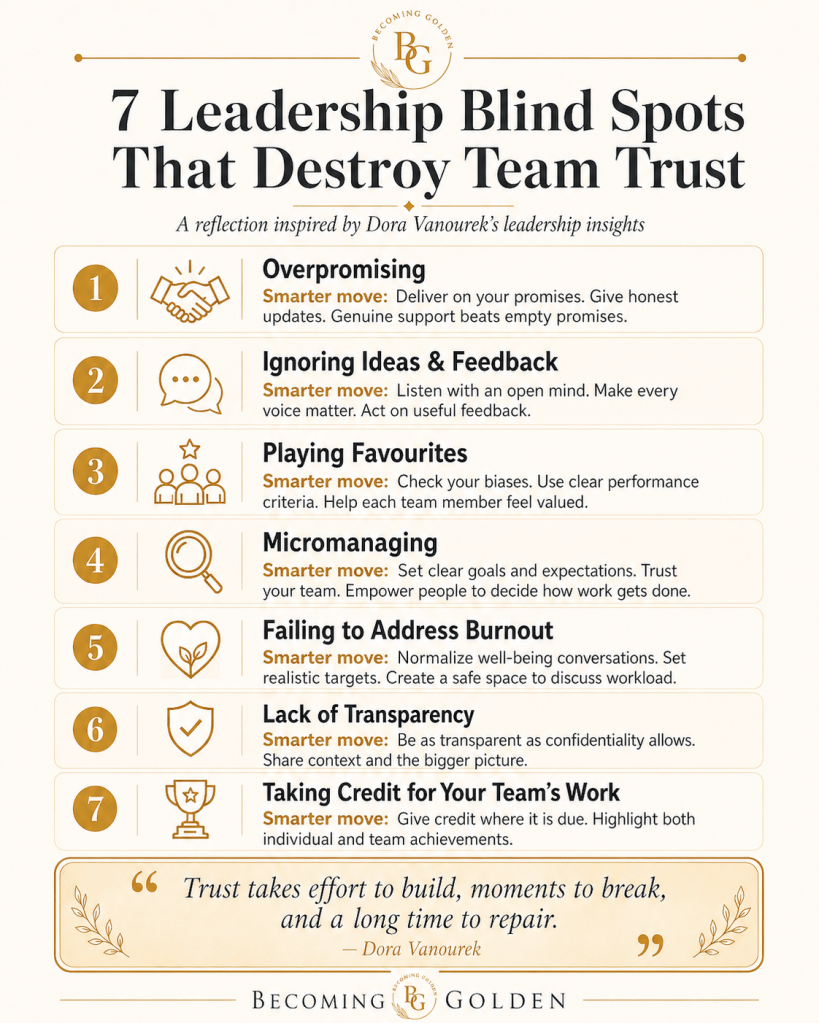
Trust is one of the most valuable currencies in leadership. It determines how openly people communicate, how committed they are to the mission, and how safe they feel contributing their best ideas.
Dora Vanourek powerfully reminds us that there are seven leadership blind spots that can destroy a team’s trust: overpromising, ignoring ideas and feedback, playing favourites, micromanaging, failing to address burnout, lack of transparency, and taking credit for the team’s work.
These blind spots are important because they are often not driven by bad intentions. Many leaders fall into them while trying to motivate, protect, guide, or support their teams. However, leadership is not judged only by intention. It is also judged by impact.
1. Overpromising
Leaders often overpromise because they want to keep their teams hopeful. They may promise resources, promotions, timelines, or opportunities before they are fully certain.
However, when promises are not fulfilled, credibility is weakened. Teams may begin to question whether the leader’s word can be trusted.
A better approach is to commit carefully, communicate honestly, and provide regular updates. Genuine support is better than empty reassurance.
2. Ignoring Ideas and Feedback
Dora also highlights the danger of ignoring ideas and feedback. Some leaders assume they are saving time by dismissing ideas that may not work. Yet, when people feel unheard, they eventually stop contributing.
Trust grows when team members know that their voices matter. This does not mean every suggestion must be adopted, but it does mean every contribution should be respected.
Leaders should listen with an open mind, acknowledge feedback, and explain decisions clearly.
3. Playing Favourites
Favouritism can quietly destroy team morale. It may begin innocently, especially when a leader naturally connects with certain people because of shared background, personality, or working style.
But when some team members consistently receive more attention, better opportunities, or more recognition, others begin to feel invisible.
Fair leadership requires self-awareness. Leaders must check their biases, apply clear performance criteria, and ensure that every team member feels valued.
4. Micromanaging
Micromanagement is often disguised as support. A leader may believe they are simply ensuring quality or helping the team succeed.
However, to the team, micromanagement can feel like distrust. It limits ownership, confidence, and creativity.
Better leadership means setting clear expectations, defining goals, and then allowing people the space to deliver. Teams grow when they are trusted to think, decide, and execute.
5. Failing to Address Burnout
One of the most dangerous assumptions a leader can make is, “They would tell me if they were struggling.”
Many people do not openly admit burnout because they fear being judged as weak, incapable, or uncommitted. Silence does not always mean people are okay.
Leaders should normalize conversations about well-being, set realistic targets, ask about workload, and model healthy work habits. Protecting people’s energy is part of protecting performance.
6. Lack of Transparency
Some leaders withhold information because they believe they are protecting the team from unnecessary stress. While confidentiality is sometimes necessary, silence can create uncertainty and mistrust.
People do not need to know everything, but they do need context.
Transparent leaders communicate what they can, explain the bigger picture, and are honest about uncertainty. Even difficult messages can build trust when delivered with clarity and respect.
7. Taking Credit for the Team’s Work
Dora’s final blind spot is especially important: taking credit for the team’s work.
Some leaders may think they are simply representing the team’s achievements. But when individual and collective contributions are not acknowledged, people feel unseen.
Strong leaders give credit generously. They highlight the people behind the results and ensure that team members are recognized in the rooms where opportunities and decisions are made.
Ultimately, Dora Vanourek’s message is a timely reminder that trust is not built by position, title, or authority. It is built through consistent behaviour. Trust grows when leaders keep their word, listen with humility, act fairly, communicate honestly, protect their teams from burnout, and give credit where it is due. As Dora rightly notes, trust takes effort to build, moments to break, and a long time to repair. Leadership therefore requires awareness: the best leaders are not perfect, but they are reflective. They pay attention not only to what they intend, but also to how their actions are experienced by others.


Leave a Reply