
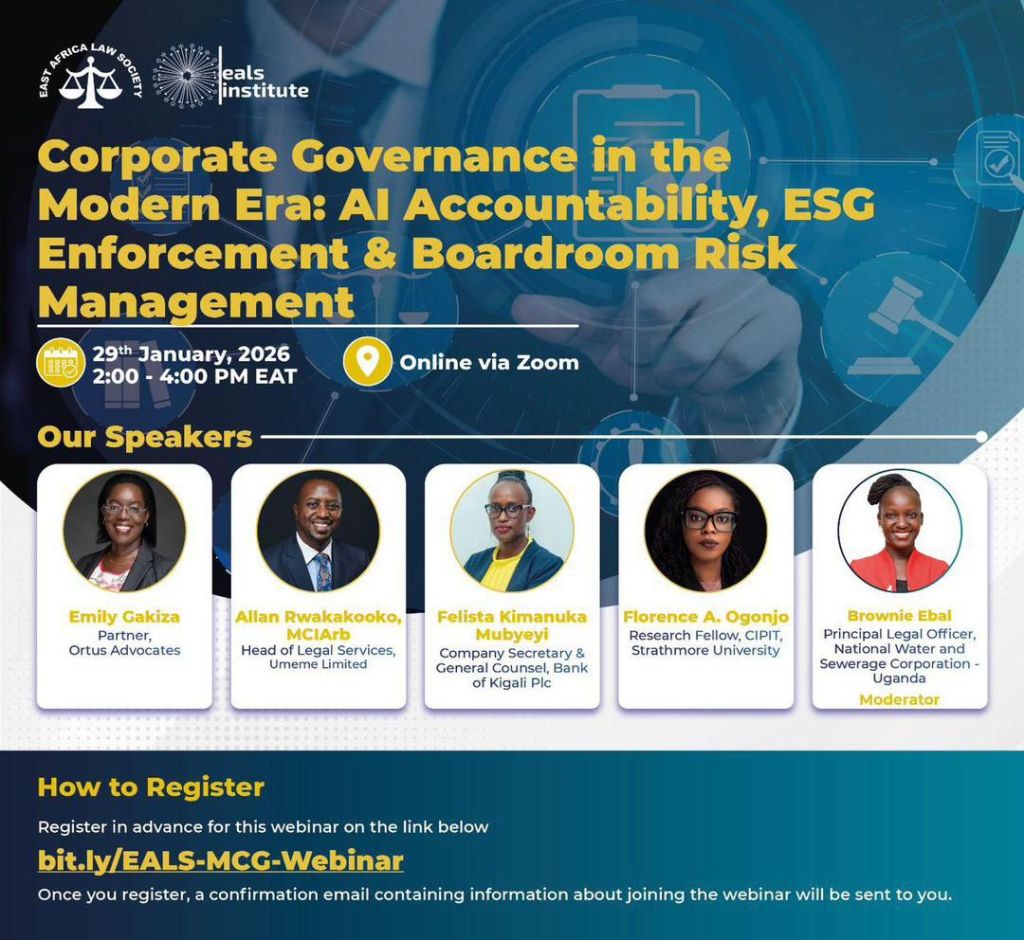
On 29th January 2026, the East Africa Law Society convened a regional webinar bringing together legal practitioners, in-house counsel, board advisers, and governance professionals to examine the evolving demands of corporate leadership. Held under the theme Corporate Governance in the Modern Era: AI Accountability, ESG Enforcement & Board Risk Management, the session explored how technology, sustainability expectations, and risk oversight are reshaping decision-making across African boardrooms.
The discussion was framed around a shared recognition that corporate governance is no longer defined solely by compliance structures or periodic board reporting. Artificial intelligence is already influencing strategic, operational, and human-resource decisions; ESG considerations are rapidly moving from voluntary commitments to measurable obligations; and boards are increasingly expected to anticipate risks that are dynamic, interconnected, and often unfamiliar. The webinar therefore sought to move beyond surface-level conversations and engage with how governance must adapt in practice.
The conversation on artificial intelligence was anchored by Florence Anyango, an advocate of the High Court of Kenya and a research fellow at Strathmore University’s Centre for Intellectual Property and Information Technology. She observed that AI systems are already embedded across sectors such as finance, recruitment, supply chains, and strategic planning, often without clear visibility at board level. By distinguishing between AI-supported, AI-triggered, and fully automated decisions, Florence illustrated how technology now shapes outcomes affecting employees, consumers, and markets. She cautioned that these developments introduce significant legal, ethical, and reputational risks, particularly where decisions are opaque, difficult to contest, or directly affect individuals. While many African jurisdictions do not yet have AI-specific legislation, she noted that existing legal frameworks on data protection, non-discrimination, labour relations, consumer protection, and human rights already impose real accountability. Drawing from regional and global instruments, including UNESCO’s ethical principles, the OECD AI guidelines, and the African Union’s AI Continental Strategy, she underscored the importance of transparency, human oversight, and a people-centred approach to AI deployment.
Building on this foundation, Emily Disa, a partner at Ortus Advocates and a seasoned finance, risk, and governance professional, shifted the focus to board-level risk management. She situated AI and ESG within a broader risk environment defined by volatility, cyber threats, climate-related disruptions, and rapid digital transformation. Emily noted that boards are increasingly expected to oversee risks they may not fully understand, yet ignorance offers no protection from liability or reputational damage. She highlighted cyber security and data governance as foundational risks, given the growing value of data and the rise of AI-enabled attacks, and warned that failures in these areas can escalate quickly into regulatory and public-trust crises. Her remarks emphasised the need for boards to integrate emerging risks into existing governance structures, strengthen oversight through dedicated committees, and invest in continuous education and scenario planning.
The discussion on sustainability and accountability was further enriched by Felista Kim Manuka, General Counsel and Company Secretary at Bank of Kigali PLC, who examined ESG from both a governance and business perspective. She explained that ESG has moved decisively from being a reputational or voluntary exercise to a strategic and regulatory priority. Felista highlighted the tangible benefits of embedding ESG into corporate strategy, including operational efficiency, enhanced investor confidence, improved access to capital, and stronger employee engagement. She also underscored the critical role of boards in setting the tone on ESG, overseeing disclosures, and guarding against greenwashing by ensuring that sustainability claims are supported by credible data and governance processes. Reference was made to emerging regional practices and global standards such as the International Sustainability Standards Board and climate-related financial disclosure frameworks, which are increasingly shaping expectations across African markets.
Offering a practitioner’s perspective, Alan Rakoko, Head of Legal Services at Umeme Limited, reflected on the growing exposure of boards, senior management, and legal advisers to personal and institutional liability. He noted that regulatory trends across the region are steadily expanding accountability beyond the corporate entity to individual decision-makers, particularly in regulated sectors. Alan emphasised that ESG reporting, AI governance, and integrated reporting are no longer optional add-ons but core components of corporate risk management. He drew attention to evolving governance frameworks, including the latest developments in the King V Report, which reinforce the need for ethical leadership, stakeholder inclusivity, digital responsibility, and proactive oversight of technology-driven risks.
Throughout the webinar, a consistent theme emerged: governance in the modern era requires anticipation rather than reaction. Whether engaging with artificial intelligence, strengthening ESG oversight, or managing board-level risk, organisations must move beyond policy adoption to meaningful implementation. The session concluded with a call for governance professionals to translate global principles into local practice, ensuring that emerging technologies and sustainability commitments are aligned with African realities, institutional capacity, and public trust.
For more, please watch full video: https://www.youtube.com/live/Ppbx3tQWsf8
 BecomingGolden
Leave a comment