
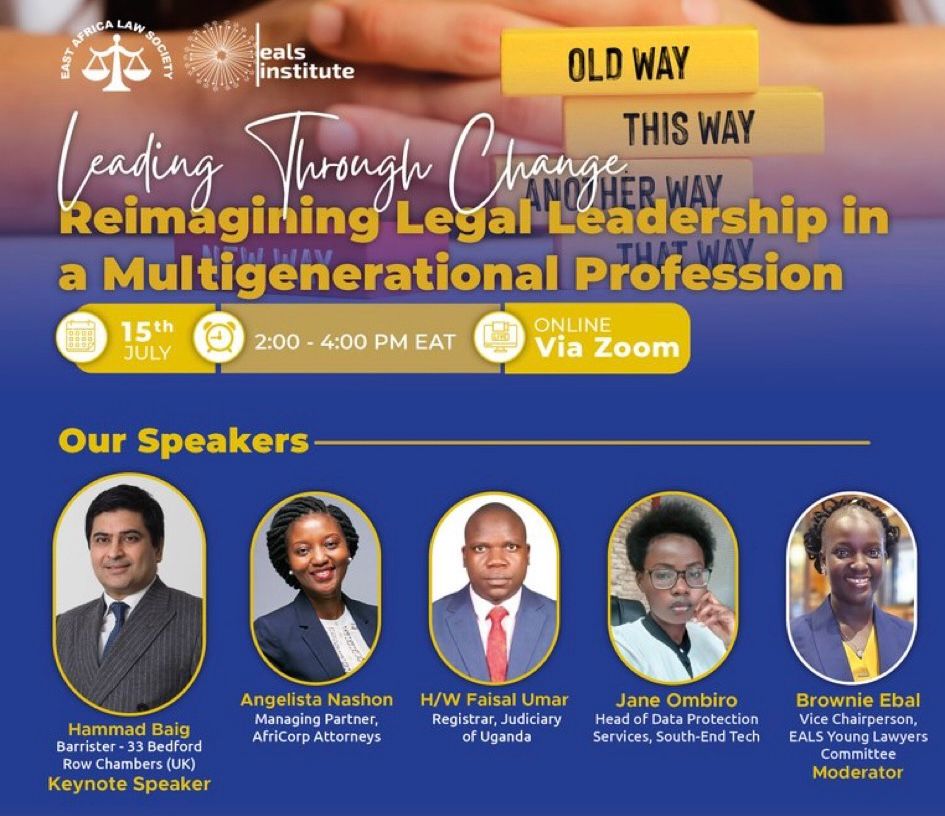
On 15th July, the East Africa Law Society (EALS) hosted a regional webinar titled “Leading Through Change: Reimagining Legal Leadership in a Multigenerational Profession.” The session brought together a dynamic blend of seasoned legal minds, judicial officers, and young innovators across East Africa and the UK. The conversation explored how different generations in the legal profession can lead together in a rapidly evolving world shaped by technology, shifting work ethics, and global complexity.
As moderator of the session, I had the honor of introducing a distinguished panel and steering the conversation toward practical reflections and forward-thinking strategies. The webinar was not only timely but necessary, as it responded to the urgent need to bridge generational divides and prepare the legal profession for the future through innovation, inclusion, and mentorship.
Mr. Hammad Baig, barrister at 33 Bedford Row Chambers in the UK, delivered the keynote address under the theme “Leading Across Generations and Borders: The Future of Legal Leadership and the Rule of Law.” Drawing on over a decade of international litigation and arbitration experience, he offered a compelling view of legal leadership grounded in agility, purpose, and integrity. Hammad underscored the increasing complexity of the legal world—where different generations now work side by side in law firms, chambers, and institutions. He painted a vivid picture of a profession being reshaped by globalization, technological disruption, and heightened expectations for social responsibility. Through anecdotes drawn from high-stakes cross-border disputes, he emphasized that leadership today requires more than legal expertise—it demands cultural fluency, digital literacy, and emotional intelligence.
One of his most powerful examples involved a senior partner, himself, and a junior associate collaborating on a case involving 180,000 archived documents. It was the junior’s AI expertise and the senior partner’s intuition that cracked the case—a perfect example of intergenerational synergy. He challenged the profession to move beyond stereotypes and instead focus on shared aspirations like meaningful work, respect, and belonging. He strongly advocated for reverse mentorship—where younger legal professionals support senior colleagues in navigating new tools, platforms, and communication norms. Hammed’s message was clear: the future of legal leadership lies in our ability to lead collaboratively across age, borders, and belief systems, while remaining uncompromising on the rule of law. His charge to the profession was to be guardians of that rule, agile in change, purposeful in vision, and unshakable in integrity.
Following this, His Worship Faisal Umar, Deputy Registrar at the High Court of Uganda, built upon the keynote by focusing on mentorship, adaptability, and the skills needed to thrive in a diverse legal workforce. He unpacked the generational landscape, from Baby Boomers who remain active in leadership and private practice, to Gen X professionals occupying senior roles, to Millennials and Gen Z who are rising fast with fresh perspectives and digital fluency. He warned against “arrivalism” among younger lawyers, encouraging them to remain teachable and purposeful, while calling on senior lawyers to nurture—not dismiss—the ambition and creativity of emerging professionals.
His Worship highlighted Uganda’s strides in judicial digitization, including the rollout of the Electronic Court Case Management System (ECCMIS), noting similar advances in Kenya, Rwanda, and South Africa. These developments, he argued, demonstrate how legal leadership must evolve with technology. He spoke candidly about how Gen Z professionals consume and produce knowledge differently, often preferring AI tools and digital libraries over traditional textbooks. He stressed the importance of emotional intelligence, urging legal leaders to offer correction without condemnation and mentorship without ego. With Africa’s population now overwhelmingly under 35, he called for intergenerational equity and institutional mechanisms that prepare the next generation without sidelining the wisdom of the current one. He noted that the law is no longer solely defined by its tradition but by its responsiveness to the realities of a changing society—where disputes involve airspace, cryptocurrencies, and transnational commerce, and where client needs demand empathy, contextual understanding, and cross-cultural agility.
Advocate Angelista Nashon, Managing Partner at Africa Attorneys in Tanzania, delivered a practical and refreshing take on how law firms and legal institutions can foster cross-generational collaboration. Drawing from her own leadership experience managing a team that includes Gen X, Millennials, and Gen Z, she emphasized that the first step to bridging generational gaps is understanding what drives each group. She offered a breakdown: Baby Boomers are structured, value face-to-face engagement, and prize job security. Gen X are pragmatic and experienced but may be slower to adapt to fluid workspaces. Millennials are purpose-driven, collaborative, and tech-adaptive. Gen Z are fast-paced, digital-first, and thrive in flexibility.
In her firm, Angelista has institutionalized a “Teach Me Something New Today” session, where even the youngest intern has the opportunity to teach a senior lawyer something practical—be it an AI tool or a new way of doing things. This, she explained, breaks hierarchy, builds mutual respect, and unlocks learning in both directions. She also addressed common frustrations, such as younger lawyers being misinterpreted as disrespectful when trying to assert themselves. Her advice: learn who you’re talking to and adapt your communication accordingly. She acknowledged that each generation brings something essential to the table, and the key to effective leadership is fostering inclusivity, workplace flexibility, and cross-generational mentorship.
Rather than resist change, Angelista argued, the legal profession must embrace it—recognizing that digital tools, evolving client expectations, and social media engagement are not threats to tradition but opportunities for relevance. She concluded with a call to celebrate generational diversity and build cultures where every voice—whether seasoned or new—is heard, valued, and empowered to contribute.
Throughout the session, participants from across East Africa shared reflections, questions, and appreciation for the insights offered. The conversation made it clear that the future of legal leadership will not be defined by age or rank, but by collaboration, cultural intelligence, and ethical conviction.
By the end of the two-hour dialogue, the collective message was unmistakable: the legal profession in East Africa must lead through change—not by clinging to outdated models, but by reimagining leadership through mentorship, inclusivity, agility, and shared purpose. As professionals, our call is to build bridges, not silos—to prepare not just for the profession as it is, but for the world as it is becoming.
For more information, please watch full video: https://www.youtube.com/live/1DjR1E-On2c
 BecomingGolden
Leave a comment