
Written by Adv. Brownie Ebal and Victoria Nakiyimba.
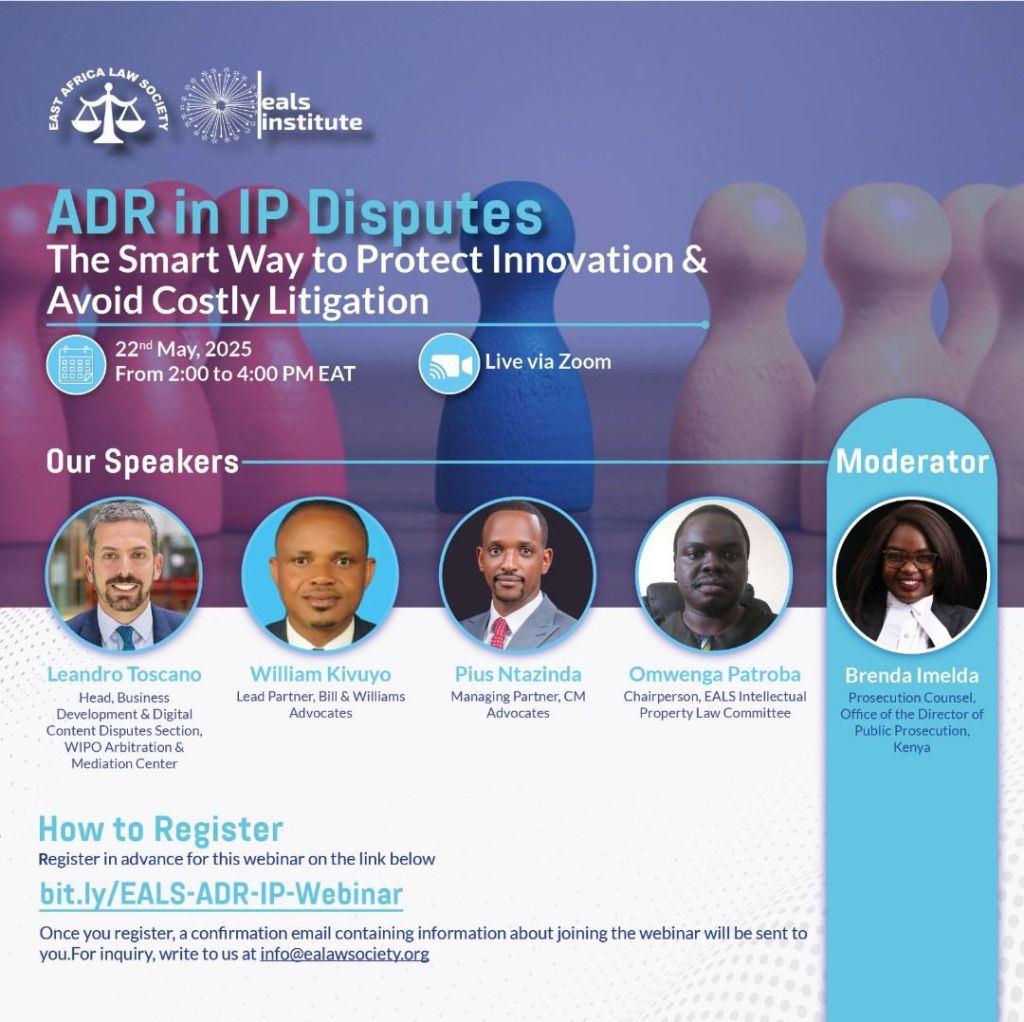
On 22nd May 2025, the East Africa Law Society (EALS), through its Intellectual Property Committee, hosted a landmark webinar titled “ADR in IP Disputes: The Smart Way to Protect Innovation and Avoid Costly Litigation.” This event brought together seasoned legal minds, IP professionals, and young practitioners from across East Africa and beyond to unpack the growing relevance of Alternative Dispute Resolution (ADR) in navigating the increasingly complex world of intellectual property.
EALS, the premier regional Bar Association, is a leading force in promoting the rule of law and professional excellence in East Africa. Through initiatives like these, it continues to position the region as a hub for legal innovation and collaboration. The session was moderated by Ms. Brenda Imelda, Prosecution Counsel, Office of the Director of Public Prosecution, Kenya, who set the tone for the discussion by highlighting how innovation today moves faster than traditional litigation can manage. She stressed the importance of equipping young lawyers with tools that enable effective and efficient conflict resolution outside the courtroom.
Mr. Leandro Toscano, representing the World Intellectual Property Organization (WIPO) in Geneva, offered a comprehensive global perspective. He began by explaining why ADR is so critical for IP disputes: the field is highly specialized, often involves international parties, and demands confidentiality and speed. He noted that 70–75% of WIPO’s cases involve parties from different jurisdictions, a testament to the global nature of IP today. ADR, he explained, provides confidentiality, cost-effectiveness, and procedural flexibility—crucial in matters involving trade secrets and sensitive commercial information. Toscano also detailed WIPO’s partnerships in Africa, such as mediation programs in Kenya and Tanzania, and highlighted a shift from ADR being used only by multinationals to now including Small and Medium Enterprises (SMEs) and individuals. In response to questions from attendees, he clarified that WIPO’s mediation process is time-flexible, usually taking two to four months, and that mediator fees are agreed upon based on the complexity of the case—ensuring affordability and fairness. Toscano also addressed opportunities for young professionals, introducing the WIPO ADR Young Program;https://www.wipo.int/amc/en/center/wipoadryoung/index.html and sharing resources such as free workshops and essay competitions to help build careers in ADR. He emphasized that aspiring mediators should combine subject-matter knowledge with soft skills like conflict resolution and emotional intelligence, while arbitrators should develop strong analytical and drafting abilities.
Advocate William Kivuyo, a seasoned IP practitioner from Tanzania, offered an East African lens. He discussed recent legal reforms that have expanded ADR access in Tanzania since 2020, including the use of independent arbitration and mediation services conducted outside of the courtroom. While these changes are encouraging, he was frank about the persistent challenges. Many clients remain skeptical of ADR, sometimes viewing a lawyer’s suggestion to mediate as a sign of weakness. Legal practitioners themselves often resist ADR, preferring the courtroom’s adversarial nature. Kivuyo pointed to a lack of trained mediators, limited awareness among the public, and inadequate infrastructure as major barriers. He illustrated this by recalling a mediation center once proposed within a court premise—an idea that was rejected to maintain neutrality, yet highlighted the struggle to establish dedicated ADR spaces. About capacity building and opportunities, Kivuyo advised law students and young professionals to develop a mental bias toward ADR early in their careers. He encouraged them to pursue apprenticeships with active ADR practitioners, especially during school breaks, and emphasized that ADR—particularly arbitration—can be more financially rewarding and time-efficient than conventional litigation. He urged African legal institutions to modernize while also drawing on traditional dispute resolution values, fostering reconciliation and cooperation over confrontation.
Advocate Patroba Omwenga offered grounded, real-time insight into the realities of IP dispute management at the Kenya Industrial Property Institute (KIPI), where he serves as a legal officer. He explained that many disputes arise from trademark registration processes, particularly during the opposition phase. Here, legal expertise is critical to evaluating the legitimacy of claims while encouraging innovation. He highlighted the need for ADR in managing these disputes efficiently, especially among (Micro, Small and Medium Enterprises) MSMEs, who make up a large portion of trademark applicants. Patroba illustrated this with specific cases, such as the ‘Big Man Bazu’ trademark registered by media personality Willis Raburu—resulting in a successful infringement suit (Civil Suit 198 of 2023), in which Airtel Kenya was ordered to pay KES 6.5 million (Ksh 5 million in special damages and Ksh 1.5 million in general damages) and was permanently restrained from using the mark— and the high‑stakes Civil Appeal No. 338 of 2013, concerning the contested registration of ‘Basmati rice’ as a trademark/geographical indication between India and Pakistan. These cases, he noted, show how IP issues can even touch diplomatic nerves, making ADR not only useful but essential. Responding to questions, Patroba explained that ADR becomes more accessible when parties see benefits such as confidentiality, speed, and cost-effectiveness. He clarified that many trademarks, including names like “Bahati,” are registered not as plain words but as stylized logos or images, making them eligible for protection. He also emphasized the need to raise IP awareness in Kenya, noting that many creators lose out on rights and compensation simply because they do not register their innovations. He encouraged more aggressive public education and simplified access to IP registration as essential steps toward empowering creators and protecting innovation.
In conclusion, the webinar underscored the growing urgency and value of ADR in resolving IP disputes across East Africa. As innovation accelerates and legal systems strain to keep pace, ADR offers a more collaborative, timely, and accessible solution. With support from regional bar associations, reform-minded governments, and global institutions like WIPO, ADR is rapidly becoming not just an alternative, but the preferred method for navigating the complexities of intellectual property. The session called on legal professionals—especially the younger generation—to embrace ADR as a strategic, forward-thinking path that honors both legal rigor and innovative spirit.
For more information, please watch the video below:
 BecomingGolden
Leave a comment