
Written by Adv. Brownie Ebal & Victoria Nakiyimba.
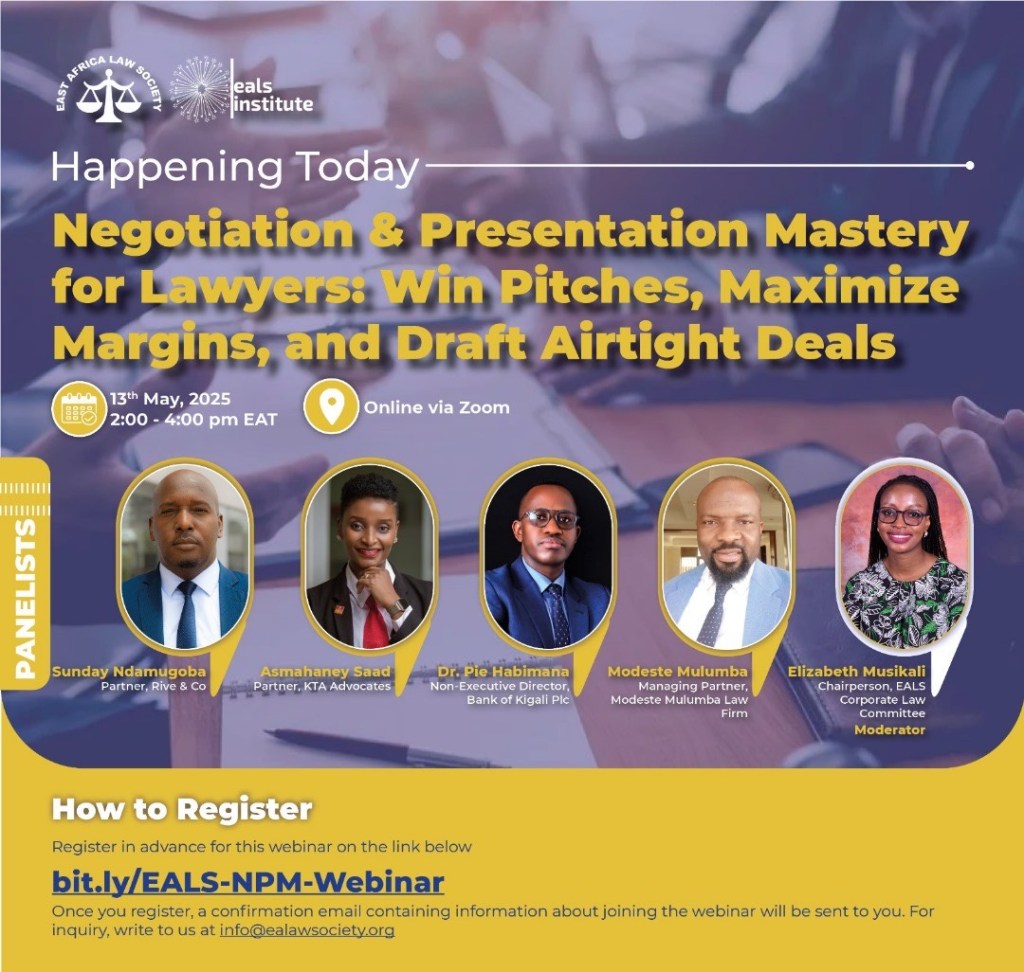
On 13th May 2025, legal professionals from across the continent tuned in for a high-impact webinar titled “Negotiation & Presentation Mastery for Lawyers: Win Pitches, Maximize Margins and Draft Airtight Deals.” Organized by the East Africa Law Society (EALS), the session attracted lawyers eager to sharpen their strategic skills in client engagement, contract drafting, and high-stakes negotiation.
The East Africa Law Society, a prominent regional bar association representing over 28,000 lawyers from across the East African Community, has long been at the forefront of advancing the rule of law, cross-border legal practice, and professional development. This session was part of its broader mission to equip legal practitioners with the tools necessary to thrive in an increasingly complex and competitive market.
The panel featured four distinguished speakers: Sunday Ndamugoba, Partner at Rive & Co; Asmahaney Saad, Partner at KTA Advocates; Dr. Pie Habimana, Non-Executive Director at Bank of Kigali Plc; and Modeste Mulumba, Managing Partner at Modest Mulumba Law Firm. Together, they offered a panoramic view of what it takes to succeed in today’s legal profession—where knowledge alone is no longer enough.
Sunday Ndamugoba delivered a comprehensive perspective on what defines a well-drafted, airtight contract in today’s complex commercial environment. Speaking from his Tanzanian legal context, he emphasized the importance of clarity and precision in language, ensuring that contracts are free from ambiguity and clearly outline obligations, timelines, and deliverables. He stressed the need for contracts to comprehensively anticipate contingencies—incorporating breach clauses, remedies, dispute resolution mechanisms, and local realities such as dual languages and sector-specific compliance. Importantly, he urged lawyers to design contracts that are not only enforceable and legally sound, but also adaptable over time. He later explored the growing role of emerging technologies like AI in contract drafting, acknowledging their usefulness in automating standard clauses and conducting reviews, while warning of the risks they pose when used without oversight. He noted that AI should remain an assistant, not a decision-maker, especially in regions where regulatory frameworks are still developing. According to Ndamugoba, the responsibility of sound judgment, client-specific strategy, and contextual awareness remains squarely with the lawyer.
Dr. Pie Habimana brought energy and clarity to the topic of pitch-making. He challenged lawyers to move beyond the conventional definitions of good legal service and begin offering strategic value. According to him, storytelling is not simply a presentation tool, it is a transformative method that allows lawyers to make complex legal arguments relatable and persuasive. He underscored that clients are no longer seeking lawyers who merely know the law, they want advisors who understand their business and help them make smart decisions. A compelling pitch, he said, should help clients see not just the legal solution, but the strategic advantage.
The discussion then shifted to negotiation, where Asmahaney Saad shared an insightful perspective grounded in her experience as both a corporate lawyer and a mediator. She reminded participants that negotiation is an everyday skill, not just a professional tool, but a part of life itself. Her approach was deeply human: she encouraged lawyers to enter negotiations prepared, to recognize the difference between a client’s wants and their needs, and to always be aware of the emotional undercurrents in the room. Drawing on relatable stories, she demonstrated how listening, empathy, and flexibility often achieve far more than rigid demands. Saad also spoke to the modern lawyer’s role as a value-driven partner, not just a service provider—especially when negotiating fees or managing client relationships in an increasingly AI-influenced world.
Modeste Mulumba added depth to the conversation with his reflections on managing pressure during high-stakes negotiations. He spoke about the importance of staying mentally centered and methodical—especially when counterparties are aggressive or dismissive. He encouraged lawyers to approach each negotiation with a clear mind, to understand each party’s goals, and to guide discussions toward mutually acceptable outcomes without losing professional composure. Mulumba also emphasized the power of calm body language and professional demeanor, particularly when trying to de-escalate tense situations.
Together, these discussions painted a picture of a profession undergoing profound transformation. Lawyers today must be far more than technically proficient—they must be persuasive communicators, thoughtful negotiators, and adaptive advisors. As the speakers made clear, legal services are no longer judged solely by their correctness, but by the strategic value and clarity they deliver to clients.
This webinar offered more than just practical tips—it was a deep and timely reflection on the evolving identity of the legal profession
For more information, please click on the link to watch full video: https://www.youtube.com/live/hJ9hpUAOeaA
 BecomingGolden
Leave a comment