
Written by Brownie Ebal and Victoria Nakiyimba.
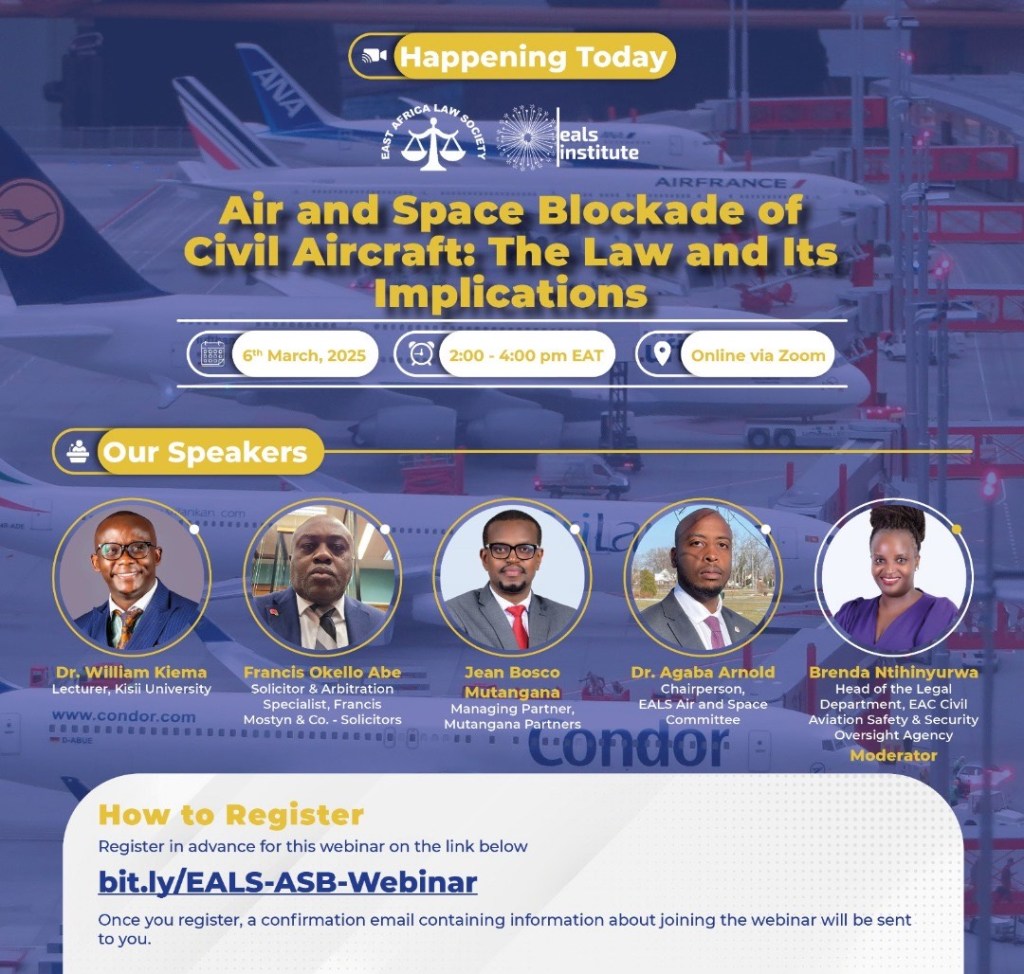
The East African Law Society is the regional Bar Association of East Africa. It was formed in 1995 and incorporated in Tanzania. The EALS has over 42,000 individual members and also has seven national Bar associations as members: Law Society of Kenya, Tanganyika Law Society, Uganda Law Society, Zanzibar Law Society, Rwanda Bar Association, Burundi Bar Association, South Sudan Bar Association and Ethiopian Federal Advocates Association. The Ethiopian Federal Advocates Association is the latest Bar Association to join the Society. One of its key roles is to develop the capacity of the legal profession to respond to emerging challenges to businesses, governance and trade, among other areas. In line with its mandate, the East African Law Society recently hosted a high-level webinar on “Air and Space Blockade of Civil Aircraft: The Law and Its Implications” on 6th March 2025. The session, convened by Arnold Agaba, Chair of the East African Law Society’s Committee on Air and Space, brought together experts to discuss the legal frameworks governing airspace closures, their practical effects, and potential dispute resolution mechanisms.
The panel featured Dr. William Kiema, a lecturer at Kisii University, Mr. Francis Okello Abe, Solicitor and Arbitration Specialist, Francis Mostyn & Co.- Solicitors, Jean Bosco Mangana, Managing partner, Mutagana Partners and an expert in international law and aviation security.
Dr. William K. provided a detailed overview of the legal instruments governing airspace blockades, emphasizing the Chicago Convention (1944) as the primary international treaty that governs state sovereignty over airspace. Article 1 of the convention affirms a state’s right to control its airspace, while Article 9 allows for airspace closures only under military necessity or public safety concerns. Additionally, the UN Charter plays a role in imposing “no-fly zones” through UN Security Council resolutions, as seen in cases such as the Libyan no-fly zone implemented for humanitarian reasons.
Mr. Francis O. explored the practical consequences of airspace restrictions, particularly their impact on aviation operations and economies. He highlighted the Russia-EU airspace restrictions as a contemporary case study, explaining how the EU’s ban on Russian aircraft in 2022 led to a retaliatory ban by Russia on 36 European nations. This forced airlines to reroute flights, leading to increased fuel costs, longer travel times, and operational inefficiencies. He pointed out that such restrictions have placed European airlines at a disadvantage, demonstrating how airspace blockades can be wielded as powerful geopolitical tools.
Mr. Jean Bosco Mutagana expanded on the diplomatic and humanitarian challenges that arise from airspace closures. While states have the right to control their airspace, these actions must balance security interests with international cooperation. Blockades can disrupt the delivery of essential services such as humanitarian aid and emergency evacuations, violate international human rights—particularly the right to free movement—and have significant economic repercussions, including trade restrictions and retaliatory sanctions. He cited the 2017 Qatar airspace blockade, imposed by Saudi Arabia, UAE, Egypt, and Bahrain, as an example of an airspace restriction with profound legal and diplomatic implications. The case was eventually brought before the International Civil Aviation Organization (ICAO) and the International Court of Justice (ICJ), where it was determined that such blockades should not be used as political coercion tools.
The discussion then turned to dispute resolution mechanisms in airspace conflicts. Dr. William K. and Mr. Francis O. highlighted that the ICAO Council is the primary body responsible for adjudicating disputes, but appeals can escalate to the ICJ, as seen in the Qatar case. However, many states prefer diplomatic negotiations or economic retaliation over legal proceedings due to enforcement challenges. Mr. Francis O. also emphasized the growing importance of Alternative Dispute Resolution (ADR), particularly mediation and arbitration, as more effective and practical means of resolving airspace disputes. He noted ongoing diplomatic discussions between the EU and Russia as an example of states seeking negotiated solutions rather than prolonged litigation.
The webinar concluded with a call for greater international coordination to prevent politically motivated airspace blockades. While states have the right to control their airspace, excessive restrictions disrupt global trade and aviation. The panelists agreed that legal frameworks must evolve to balance national security concerns with economic and humanitarian interests. They also highlighted the need for more lawyers specializing in aviation law, particularly in Africa, where air transport is critical for economic growth and regional integration. The panel also highlighted that airspace closures should remain a last resort rather than a geopolitical tool.
As air travel continues to shape global diplomacy and trade, the role of legal frameworks in regulating airspace blockades will remain a crucial area for legal and policy debates.
For more information about the East African law Society and the industry experts kindly visit the EALS website on: https://ealawsociety.org/
 BecomingGolden
Leave a comment